
Improving Flytern’s Booking Flow Through Usability Insights
Improving Flytern’s Booking Flow Through Usability Insights
Team
Team
1x Product designer (me)
1x Front-end developer
1x QA engineer
1x Product designer (me)
1x Front-end developer
1x QA engineer
1x Product designer (me)
1x Front-end developer
1x QA engineer
Research Methods
Research Methods
User research
User interviews
Usability Testing
Prototyping
Interaction design
Visual design
Dev hand-off
User research
User interviews
Usability Testing
Prototyping
Interaction design
Visual design
Dev hand-off
User research
User interviews
Usability Testing
Prototyping
Interaction design
Visual design
Dev hand-off
Intro
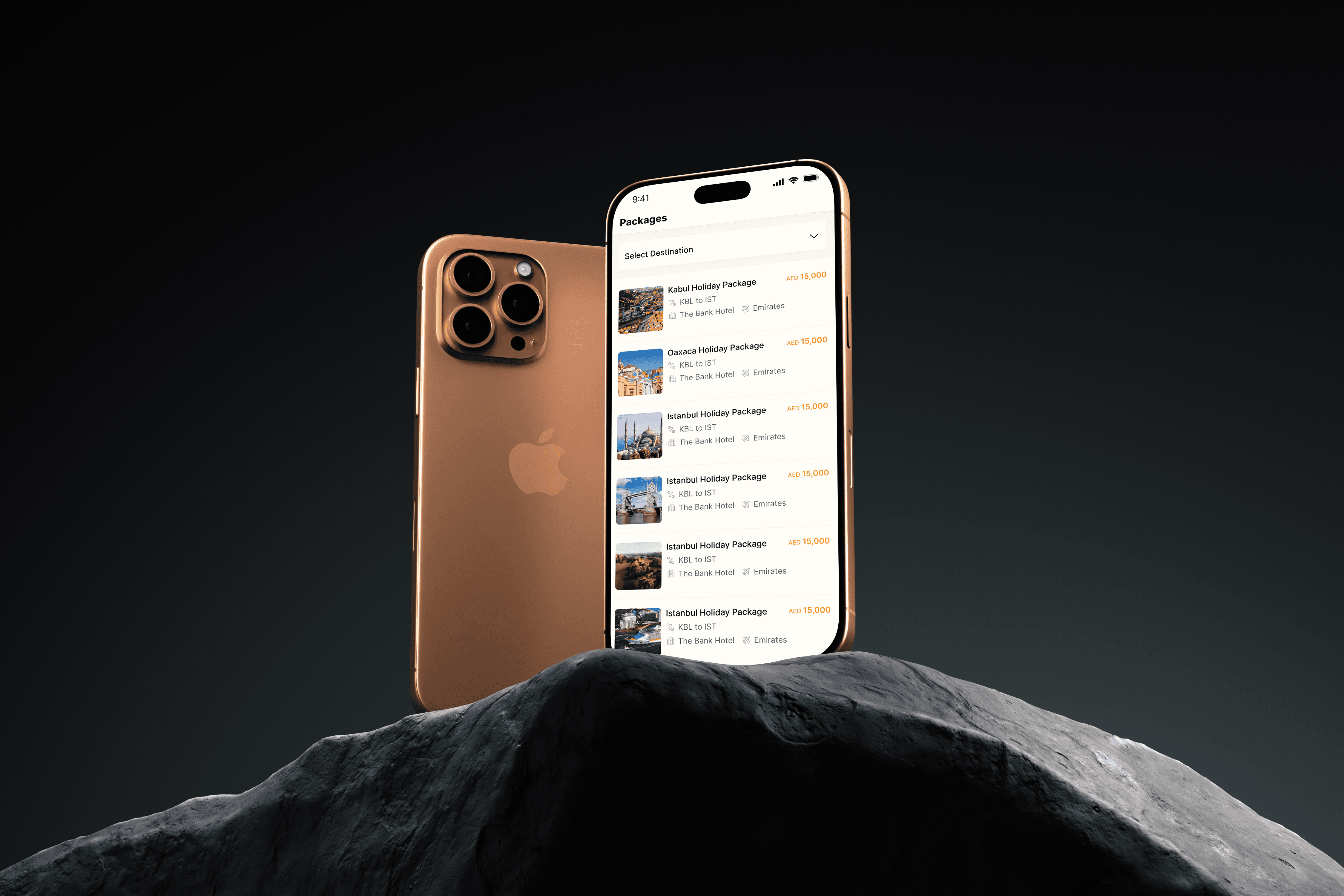
Flytern is a travel booking app that allows users to book flights, hotels, vacation packages, and travel insurance all in one platform.
The Problem Space
What is Flytern?
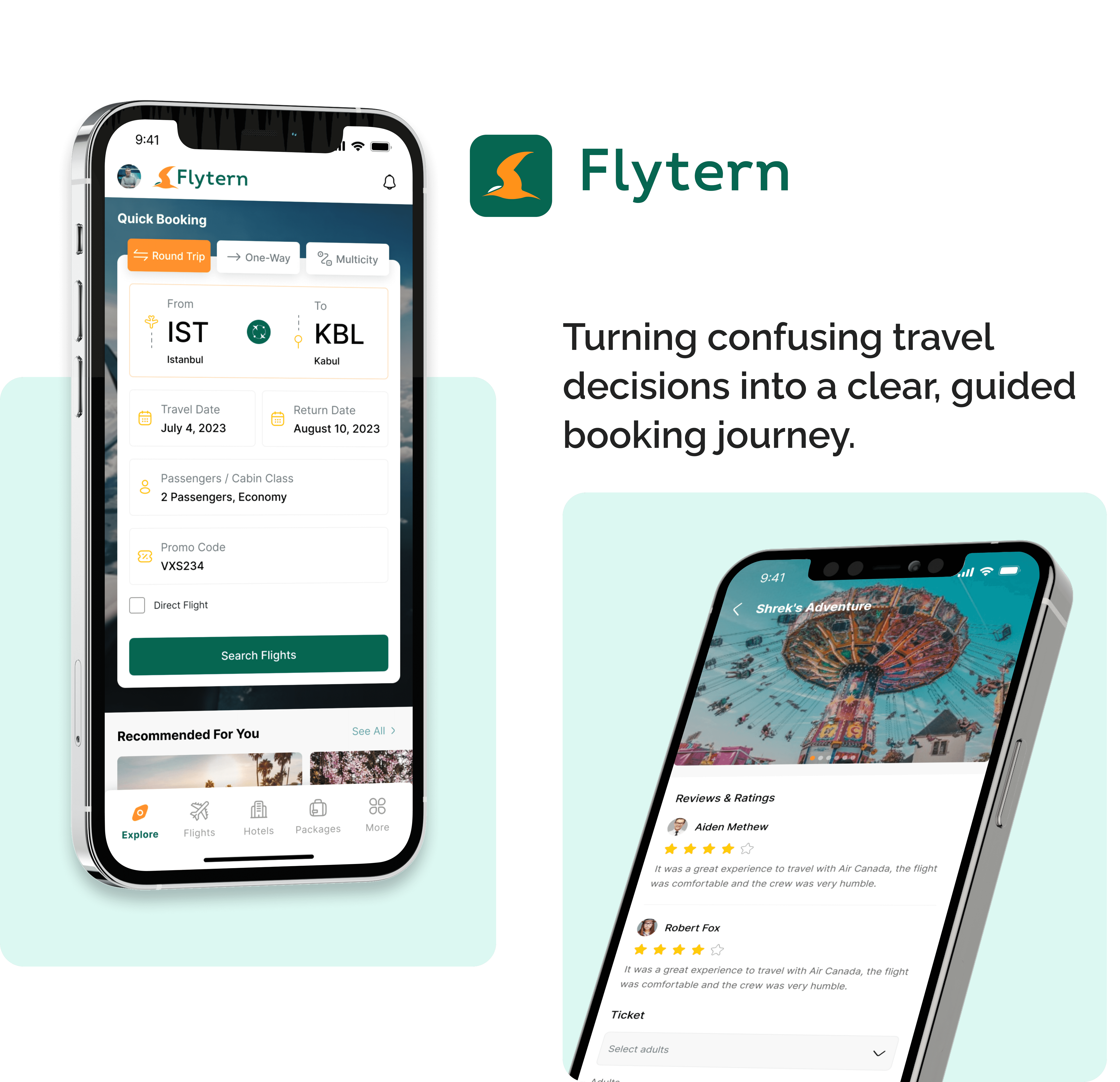
Flytern is a travel-tech app built to simplify how people plan and book their trips. Users can browse flights, compare hotels, and manage their bookings all in one place.
However, user testing revealed that booking flows were complex, add-ons were hidden, and important actions were easy to miss.
The core opportunity
Booking a flight or hotel involves multiple steps, decisions, and confirmations.
The goal was to simplify this journey while improving clarity, hierarchy, and discoverability of features such as travel insurance and seat selection.
Existing user expectations
Easy navigation and booking flow
Transparent pricing and add-ons
Visible filters and clear sorting options
Intuitive, visually clear design
Initial Problem Statement
How might we help users easily complete their bookings and explore Flytern’s full range of services without confusion or friction?
To narrow the scope, the challenge was divided into three key goals:
ATTRACT
Encourage users to explore Flytern’s all-in-one travel options through a seamless flow.
RETAIN
Build user trust by improving feature visibility, clarity, and usability.
ENGAGE
Simplify the booking process to increase task success rate and reduce drop-offs.
Intro
Intro
Intro
Flytern is a travel booking app that allows users to book flights, hotels, vacation packages, and travel insurance all in one platform.
Flytern is a travel booking app that allows users to book flights, hotels, vacation packages, and travel insurance all in one platform.
Flytern is a travel booking app that allows users to book flights, hotels, vacation packages, and travel insurance all in one platform.
The Problem Space
The Problem Space
The Problem Space
What is Flytern?
What is Flytern?
What is Flytern?
Flytern is a travel-tech app built to simplify how people plan and book their trips. Users can browse flights, compare hotels, and manage their bookings all in one place.
However, user testing revealed that booking flows were complex, add-ons were hidden, and important actions were easy to miss.
Flytern is a travel-tech app built to simplify how people plan and book their trips. Users can browse flights, compare hotels, and manage their bookings all in one place.
However, user testing revealed that booking flows were complex, add-ons were hidden, and important actions were easy to miss.
Flytern is a travel-tech app built to simplify how people plan and book their trips. Users can browse flights, compare hotels, and manage their bookings all in one place.
However, user testing revealed that booking flows were complex, add-ons were hidden, and important actions were easy to miss.
The core opportunity
The core opportunity
The core opportunity
Booking a flight or hotel involves multiple steps, decisions, and confirmations.
The goal was to simplify this journey while improving clarity, hierarchy, and discoverability of features such as travel insurance and seat selection.
Booking a flight or hotel involves multiple steps, decisions, and confirmations.
The goal was to simplify this journey while improving clarity, hierarchy, and discoverability of features such as travel insurance and seat selection.
Booking a flight or hotel involves multiple steps, decisions, and confirmations.
The goal was to simplify this journey while improving clarity, hierarchy, and discoverability of features such as travel insurance and seat selection.
Existing user expectations
Existing user expectations
Existing user expectations
Easy navigation and booking flow
Easy navigation and booking flow
Transparent pricing and add-ons
Transparent pricing and add-ons
Visible filters and clear sorting options
Visible filters and clear sorting options
Intuitive, visually clear design
Intuitive, visually clear design
Initial Problem Statement
Initial Problem Statement
Initial Problem Statement
How might we help users easily complete their bookings and explore Flytern’s full range of services without confusion or friction?
How might we help users easily complete their bookings and explore Flytern’s full range of services without confusion or friction?
How might we help users easily complete their bookings and explore Flytern’s full range of services without confusion or friction?
To narrow the scope, the challenge was divided into three key goals:
To narrow the scope, the challenge was divided into three key goals:
To narrow the scope, the challenge was divided into three key goals:
ATTRACT
ATTRACT
ATTRACT
Encourage users to explore Flytern’s all-in-one travel options through a seamless flow.
Encourage users to explore Flytern’s all-in-one travel options through a seamless flow.
Encourage users to explore Flytern’s all-in-one travel options through a seamless flow.
RETAIN
RETAIN
RETAIN
Build user trust by improving feature visibility, clarity, and usability.
Build user trust by improving feature visibility, clarity, and usability.
Build user trust by improving feature visibility, clarity, and usability.
ENGAGE
ENGAGE
ENGAGE
Simplify the booking process to increase task success rate and reduce drop-offs.
Simplify the booking process to increase task success rate and reduce drop-offs.
Simplify the booking process to increase task success rate and reduce drop-offs.
Designing for the Traveler’s Mindset
Designing for the Traveler’s Mindset
Designing for the Traveler’s Mindset
Designing for the Traveler’s Mindset
Constraints
Constraints
Constraints
Constraints
Users vary in digital literacy so designs must be intuitive.
Users vary in digital literacy so designs must be intuitive.
Users vary in digital literacy so designs must be intuitive.
Users vary in digital literacy so designs must be intuitive.
Booking decisions are time-sensitive so interactions must be fast and responsive.
Booking decisions are time-sensitive so interactions must be fast and responsive.
Booking decisions are time-sensitive so interactions must be fast and responsive.
Booking decisions are time-sensitive so interactions must be fast and responsive.
Travel add-ons (like insurance) are optional, so discoverability without interruption is key.
Travel add-ons (like insurance) are optional, so discoverability without interruption is key.
Travel add-ons (like insurance) are optional, so discoverability without interruption is key.
Travel add-ons (like insurance) are optional, so discoverability without interruption is key.
The app must be optimized for both casual and frequent travelers.
The app must be optimized for both casual and frequent travelers.
The app must be optimized for both casual and frequent travelers.
The app must be optimized for both casual and frequent travelers.
Empathizing with Users
Empathizing with Users
Empathizing with Users
Empathizing with Users
Before jumping to design solutions, I conducted both quantitative and qualitative research to understand where and why users struggled.
The research was conducted through Maze usability tests, in-app surveys, and one-on-one interviews.
Before jumping to design solutions, I conducted both quantitative and qualitative research to understand where and why users struggled.
The research was conducted through Maze usability tests, in-app surveys, and one-on-one interviews.
Before jumping to design solutions, I conducted both quantitative and qualitative research to understand where and why users struggled.
The research was conducted through Maze usability tests, in-app surveys, and one-on-one interviews.
Before jumping to design solutions, I conducted both quantitative and qualitative research to understand where and why users struggled.
The research was conducted through Maze usability tests, in-app surveys, and one-on-one interviews.
Quantitative Research
Quantitative Research
Quantitative Research
Quantitative Research
In-app survey (via Maze)
In-app survey (via Maze)
In-app survey (via Maze)
In-app survey (via Maze)
Yes (80%)
Yes (80%)
Yes (80%)
No (20%)
No (20%)
No (20%)
Have you used flight booking apps before?
Have you used flight booking apps before?
Have you used flight booking apps before?
Have you used flight booking apps before?
How often do you book flights or hotels using apps?
How often do you book flights or hotels using apps?
How often do you book flights or hotels using apps?
How often do you book flights or hotels using apps?
Rarely (60%)
Rarely (60%)
Rarely (60%)
Yearly (39%)
Yearly (39%)
Yearly (39%)
Monthly (1%)
Monthly (1%)
Monthly (1%)
User Interviews
User Interviews
User Interviews
User Interviews
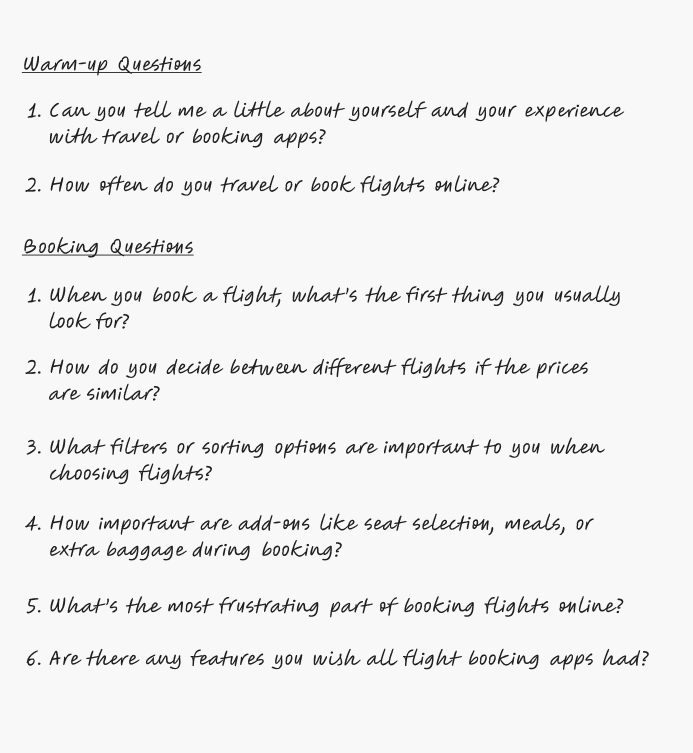
To get deeper insights, I conducted 10 user interviews to explore their experience with booking flows and expectations from travel apps.
To get deeper insights, I conducted 10 user interviews to explore their experience with booking flows and expectations from travel apps.
To get deeper insights, I conducted 10 user interviews to explore their experience with booking flows and expectations from travel apps.
To get deeper insights, I conducted 10 user interviews to explore their experience with booking flows and expectations from travel apps.
Interviews: 10
Duration: 30–40 mins
Platform: Google Meet
Type: 1:1 moderated sessions
Interviews: 10
Duration: 30–40 mins
Platform: Google Meet
Type: 1:1 moderated sessions
Interviews: 10
Duration: 30–40 mins
Platform: Google Meet
Type: 1:1 moderated sessions
Interviews: 10
Duration: 30–40 mins
Platform: Google Meet
Type: 1:1 moderated sessions
Key takeaways
Key takeaways
Key takeaways
Key takeaways
Users want fewer screens during checkout.
Users want fewer screens during checkout.
Users want fewer screens during checkout.
Users want fewer screens during checkout.
Filters and extras must be visible without scrolling.
Filters and extras must be visible without scrolling.
Filters and extras must be visible without scrolling.
Filters and extras must be visible without scrolling.
Price transparency drives decision-making.
Price transparency drives decision-making.
Price transparency drives decision-making.
Price transparency drives decision-making.
Add-ons like insurance should appear before payment, not hidden away.
Add-ons like insurance should appear before payment, not hidden away.
Add-ons like insurance should appear before payment, not hidden away.
Add-ons like insurance should appear before payment, not hidden away.
Comprehending Data from the Research
Comprehending Data from the Research
Comprehending Data from the Research
Comprehending Data from the Research
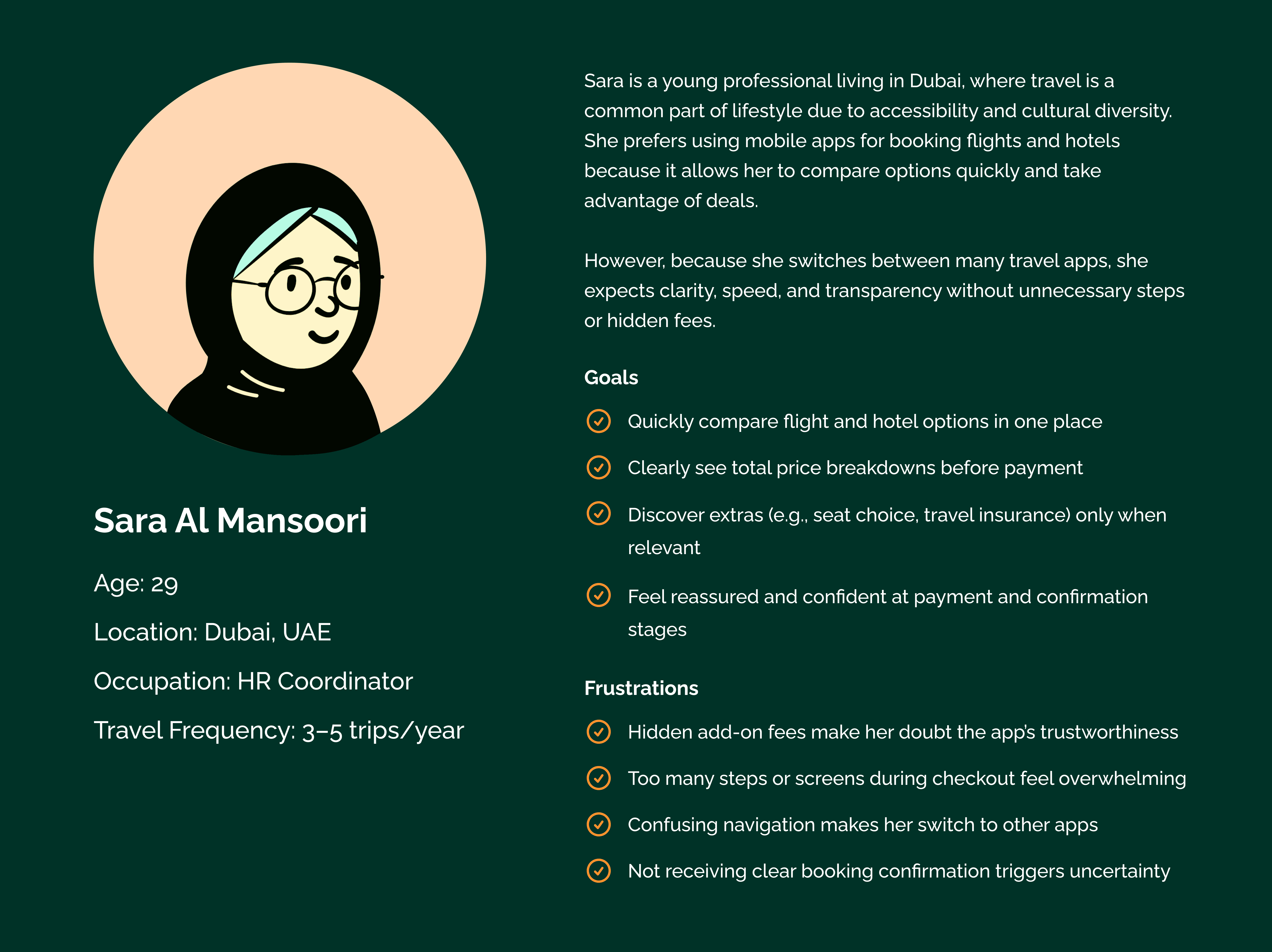
Using data from both Maze and interviews, two main user personas emerged:
Using data from both Maze and interviews, two main user personas emerged:
Using data from both Maze and interviews, two main user personas emerged:
Using data from both Maze and interviews, two main user personas emerged:
The Planner; who books in advance, values control and clarity.
The Spontaneous Traveler; who books quickly, expects intuitive and minimal steps.
The Planner; who books in advance, values control and clarity.
The Spontaneous Traveler; who books quickly, expects intuitive and minimal steps.
The Planner; who books in advance, values control and clarity.
The Spontaneous Traveler; who books quickly, expects intuitive and minimal steps.
The Planner; who books in advance, values control and clarity.
The Spontaneous Traveler; who books quickly, expects intuitive and minimal steps.
Re-defined Problem Statement
Re-defined Problem Statement
Re-defined Problem Statement
Re-defined Problem Statement
How might we streamline the booking experience for all types of travelers, ensuring clarity, discoverability, and confidence throughout the process?
How might we streamline the booking experience for all types of travelers, ensuring clarity, discoverability, and confidence throughout the process?
How might we streamline the booking experience for all types of travelers, ensuring clarity, discoverability, and confidence throughout the process?
How might we streamline the booking experience for all types of travelers, ensuring clarity, discoverability, and confidence throughout the process?
Design Ideation
Design Ideation
Design Ideation
Design Ideation
After gathering insights from user interviews and Maze usability tests, we moved into the ideation phase to explore possible solutions for the booking challenges identified.
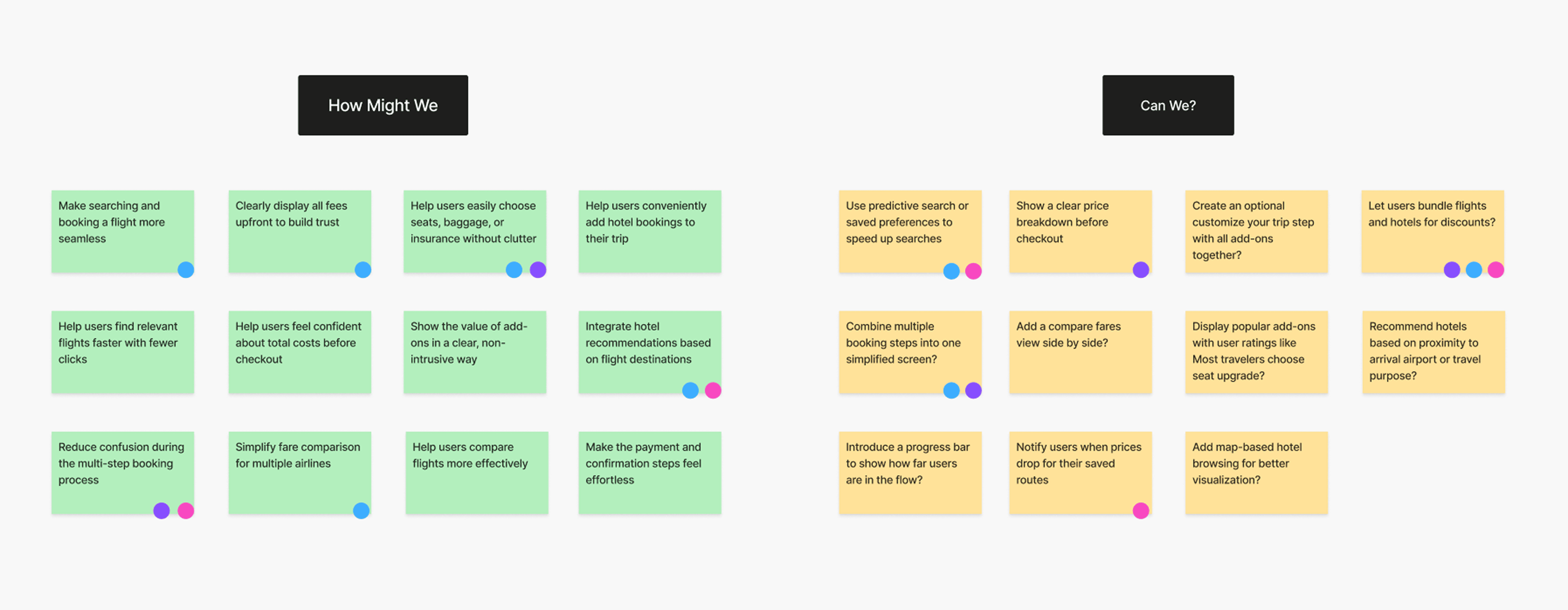
The team conducted an interactive brainstorming workshop to generate ideas focused on improving the flight and hotel booking experience. Using “How Might We” and “Can We” frameworks, we explored some ideas
During the session, the team was split into small groups to discuss, sketch, and defend their concepts.
Ideas were then clustered into two main opportunity areas:
After gathering insights from user interviews and Maze usability tests, we moved into the ideation phase to explore possible solutions for the booking challenges identified.
The team conducted an interactive brainstorming workshop to generate ideas focused on improving the flight and hotel booking experience. Using “How Might We” and “Can We” frameworks, we explored some ideas
During the session, the team was split into small groups to discuss, sketch, and defend their concepts.
Ideas were then clustered into two main opportunity areas:
After gathering insights from user interviews and Maze usability tests, we moved into the ideation phase to explore possible solutions for the booking challenges identified.
The team conducted an interactive brainstorming workshop to generate ideas focused on improving the flight and hotel booking experience. Using “How Might We” and “Can We” frameworks, we explored some ideas
During the session, the team was split into small groups to discuss, sketch, and defend their concepts.
Ideas were then clustered into two main opportunity areas:
After gathering insights from user interviews and Maze usability tests, we moved into the ideation phase to explore possible solutions for the booking challenges identified.
The team conducted an interactive brainstorming workshop to generate ideas focused on improving the flight and hotel booking experience. Using “How Might We” and “Can We” frameworks, we explored some ideas
During the session, the team was split into small groups to discuss, sketch, and defend their concepts.
Ideas were then clustered into two main opportunity areas:
Concept Building
Concept Building
Concept Building
Concept Building
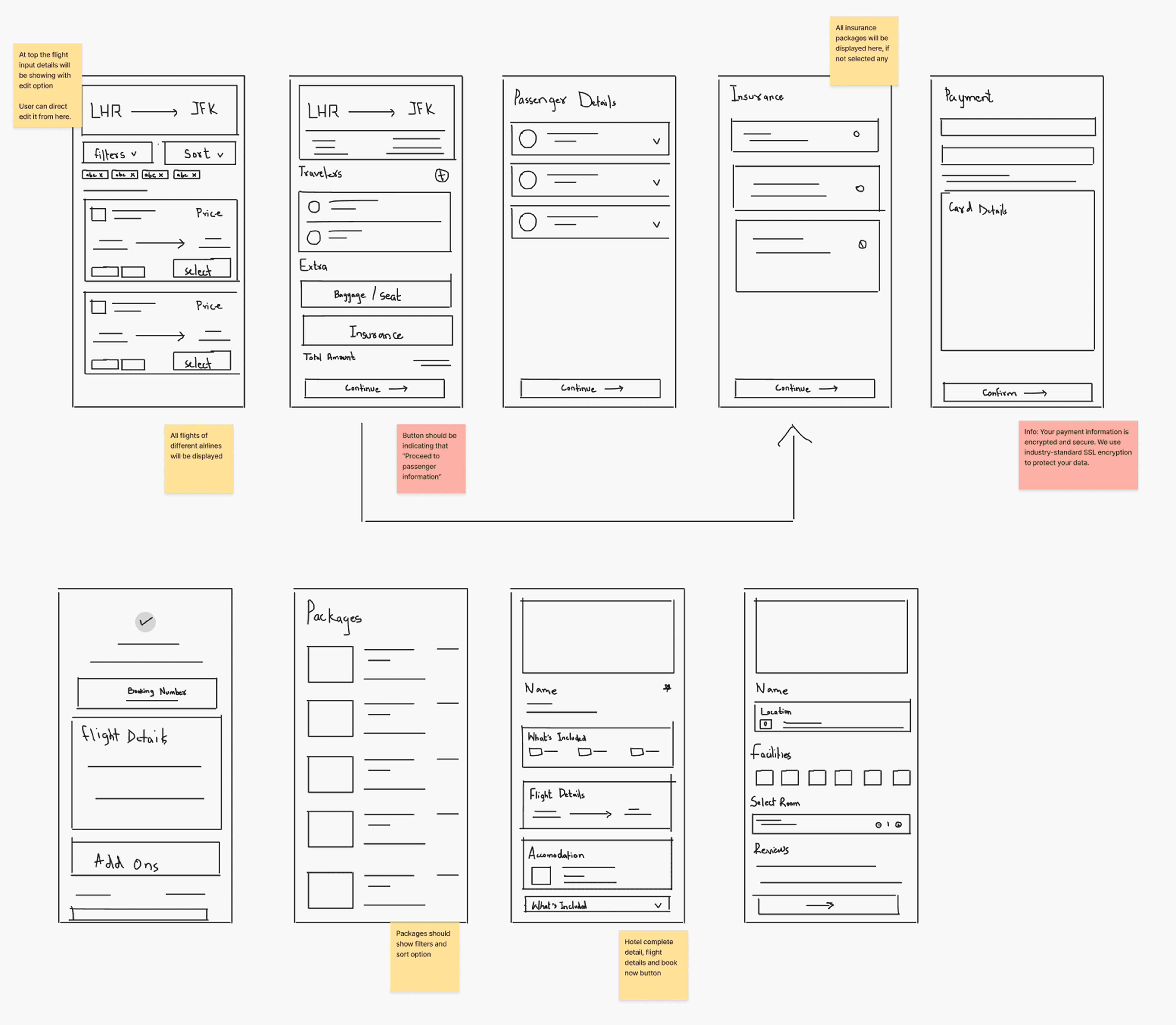
We sketched multiple flow improvements focusing on:
We sketched multiple flow improvements focusing on:
We sketched multiple flow improvements focusing on:
We sketched multiple flow improvements focusing on:
Simplified checkout
Simplified checkout
Simplified checkout
Simplified checkout
Sticky filters
Sticky filters
Sticky filters
Sticky filters
Visible extras section
Visible extras section
Visible extras section
Visible extras section
Clearer icon labeling
Clearer icon labeling
Clearer icon labeling
Clearer icon labeling
Low-fidelity wireframes were created to validate ideas before visual exploration.
Low-fidelity wireframes were created to validate ideas before visual exploration.
Low-fidelity wireframes were created to validate ideas before visual exploration.
Low-fidelity wireframes were created to validate ideas before visual exploration.
Moodboarding
Moodboarding
Moodboarding
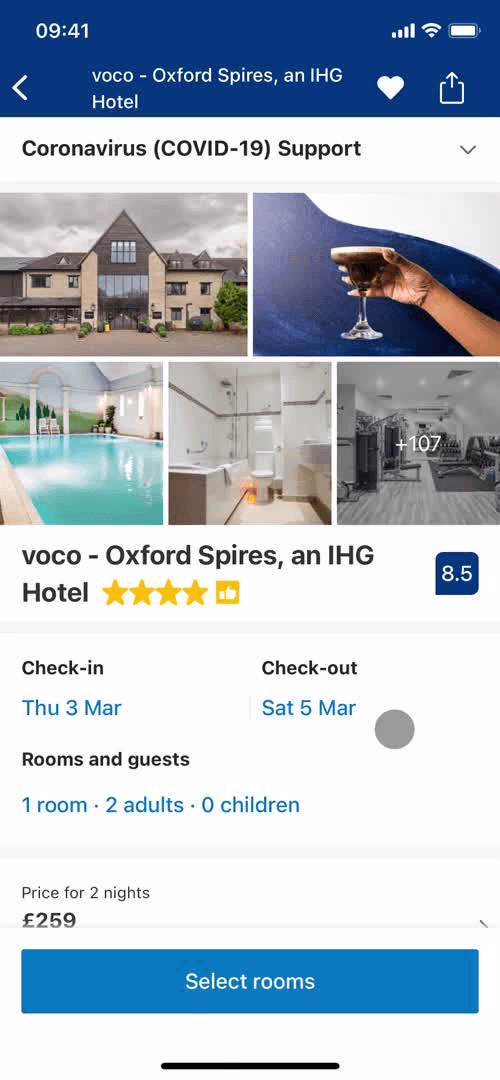
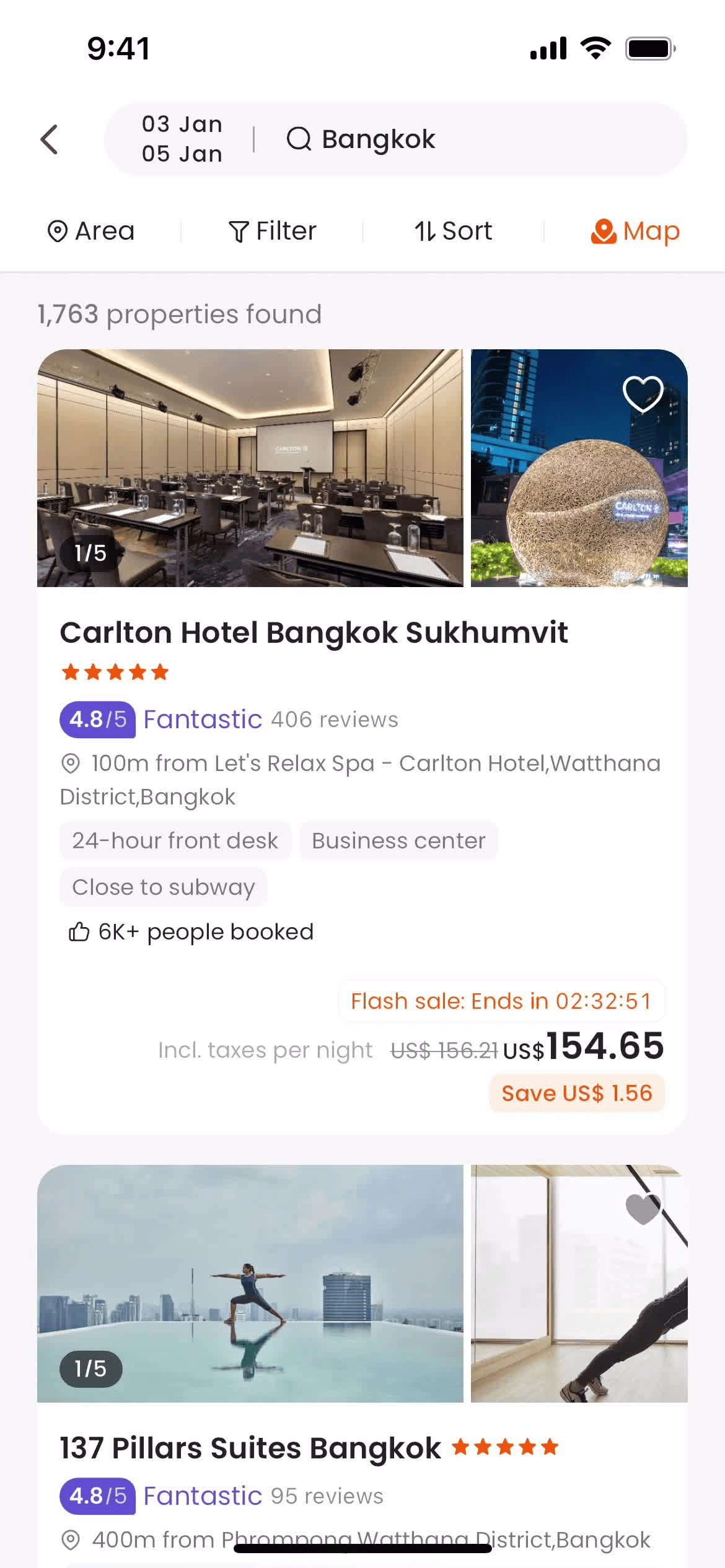
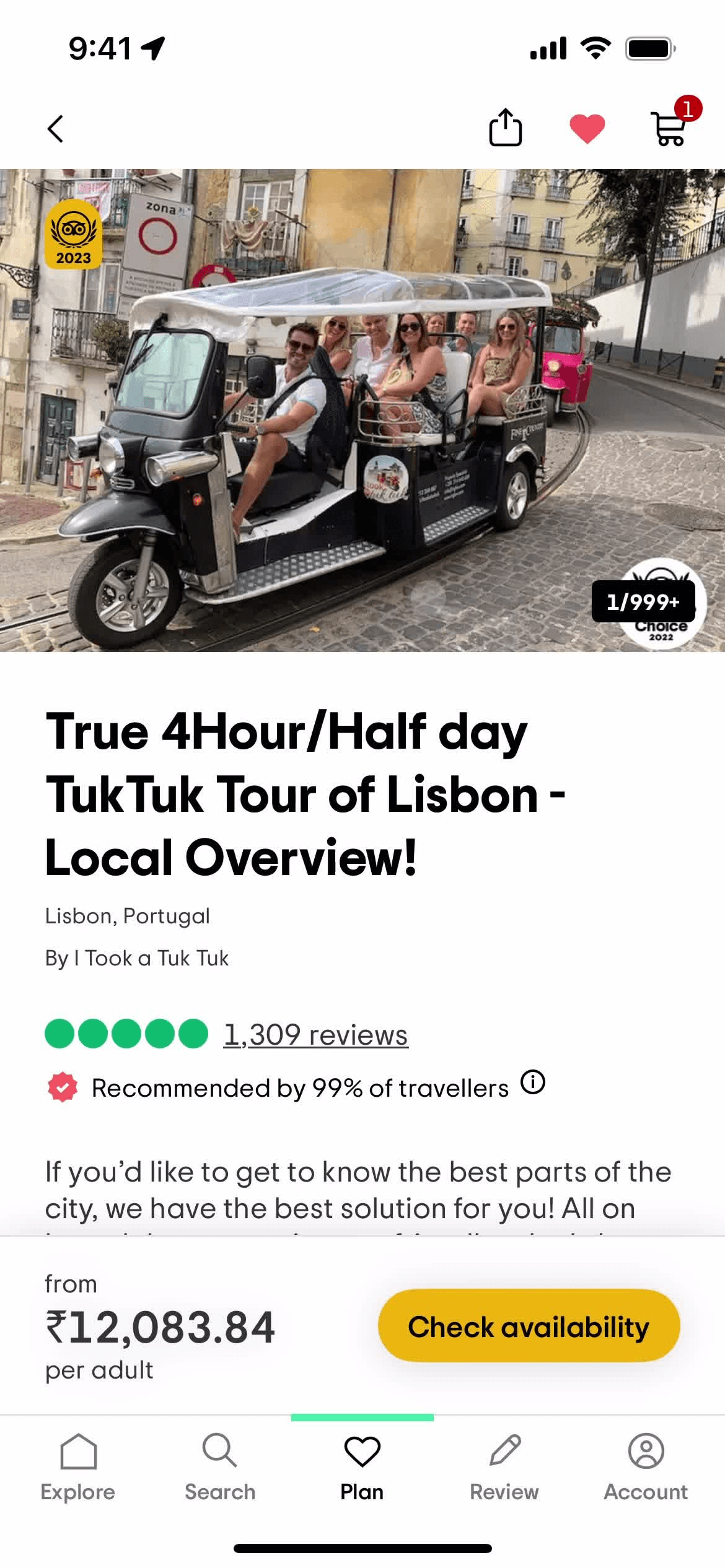
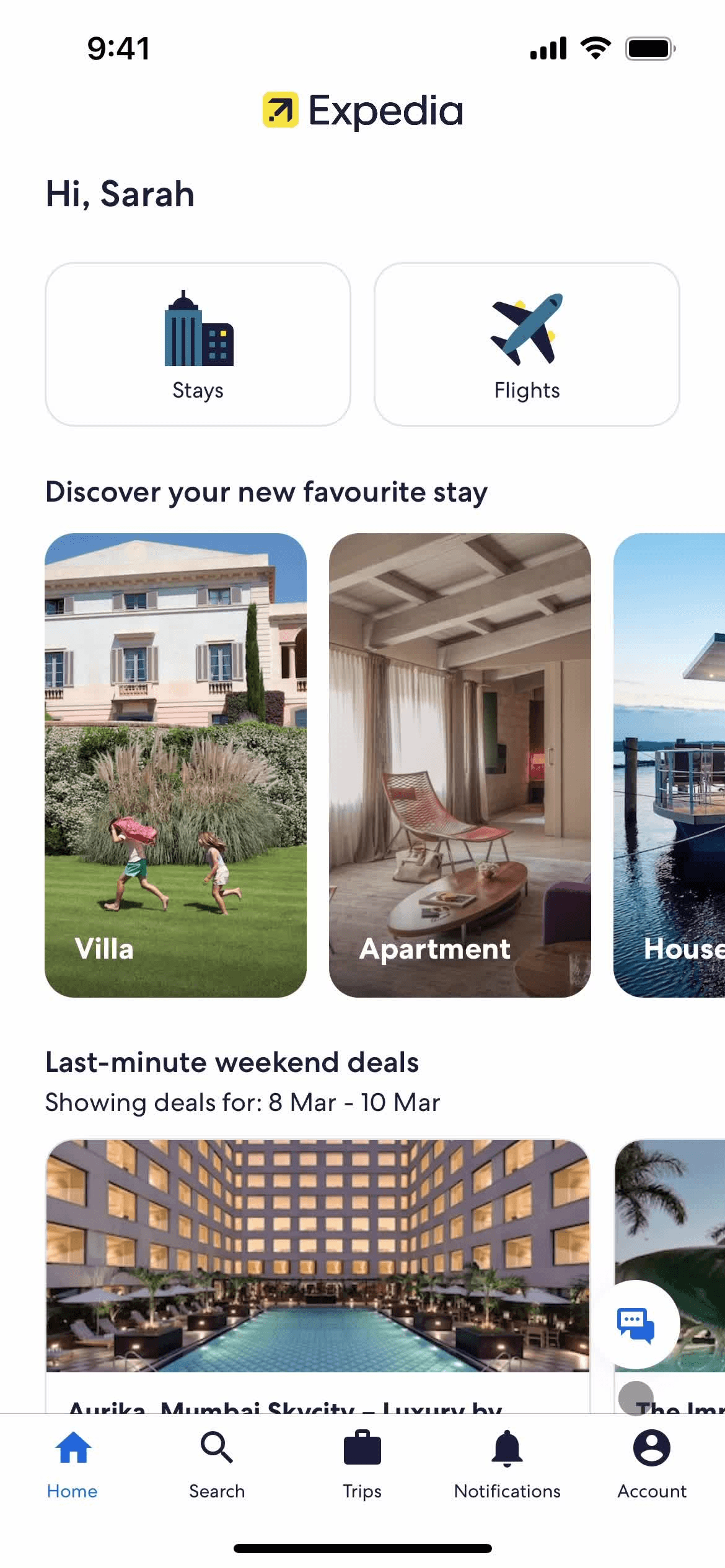
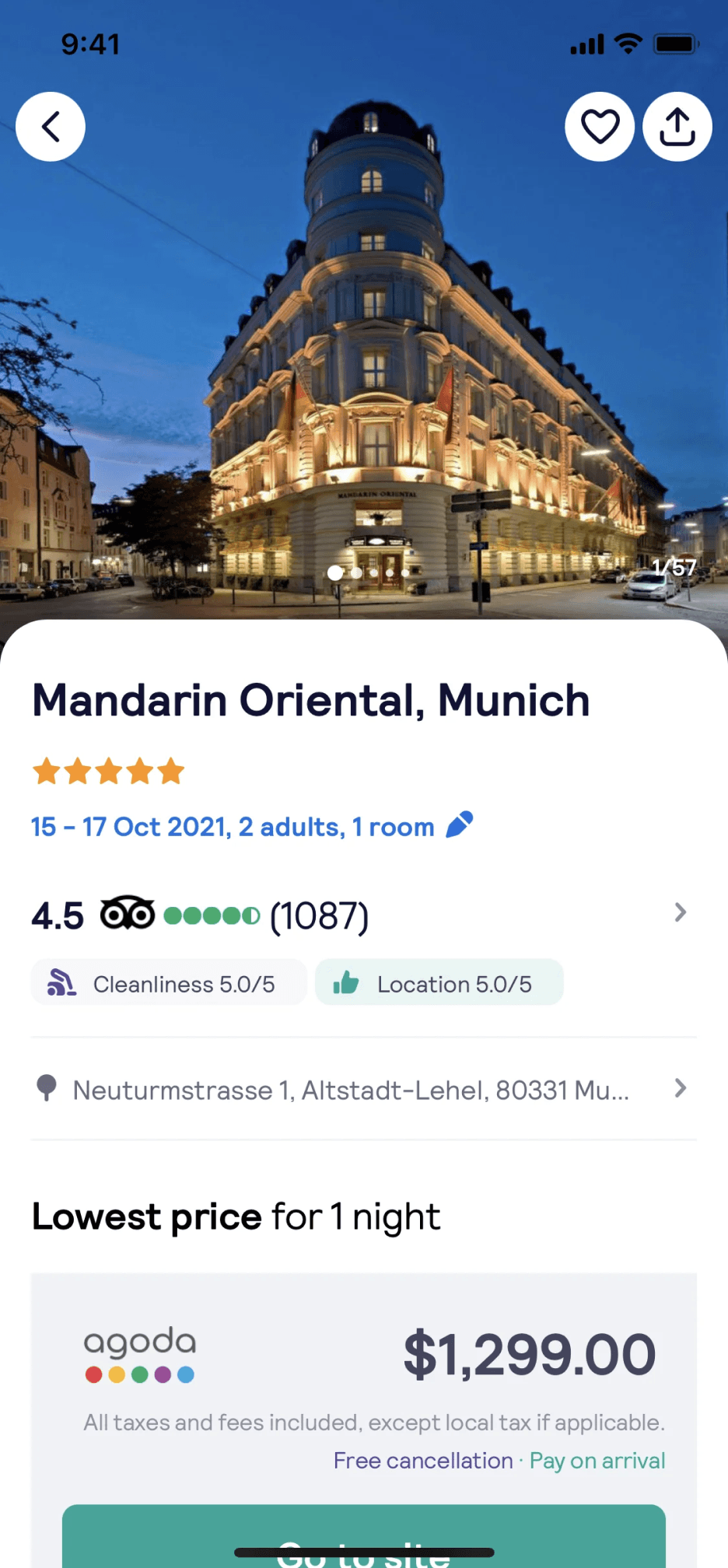
I analyzed travel apps like Booking.com, Skyscanner, and Expedia to understand modern expectations.
Additionally, lifestyle and productivity apps inspired ideas around clarity, hierarchy, and motivation in task completion.
I analyzed travel apps like Booking.com, Skyscanner, and Expedia to understand modern expectations.
Additionally, lifestyle and productivity apps inspired ideas around clarity, hierarchy, and motivation in task completion.
I analyzed travel apps like Booking.com, Skyscanner, and Expedia to understand modern expectations.
Additionally, lifestyle and productivity apps inspired ideas around clarity, hierarchy, and motivation in task completion.
Booking
Booking
Booking
Klook
Klook
Klook
Tripadvisor
Tripadvisor
Tripadvisor
Expedia
Expedia
Expedia
Skyscanner
Skyscanner
Skyscanner
Defining the Structure
Defining the Structure
Defining the Structure
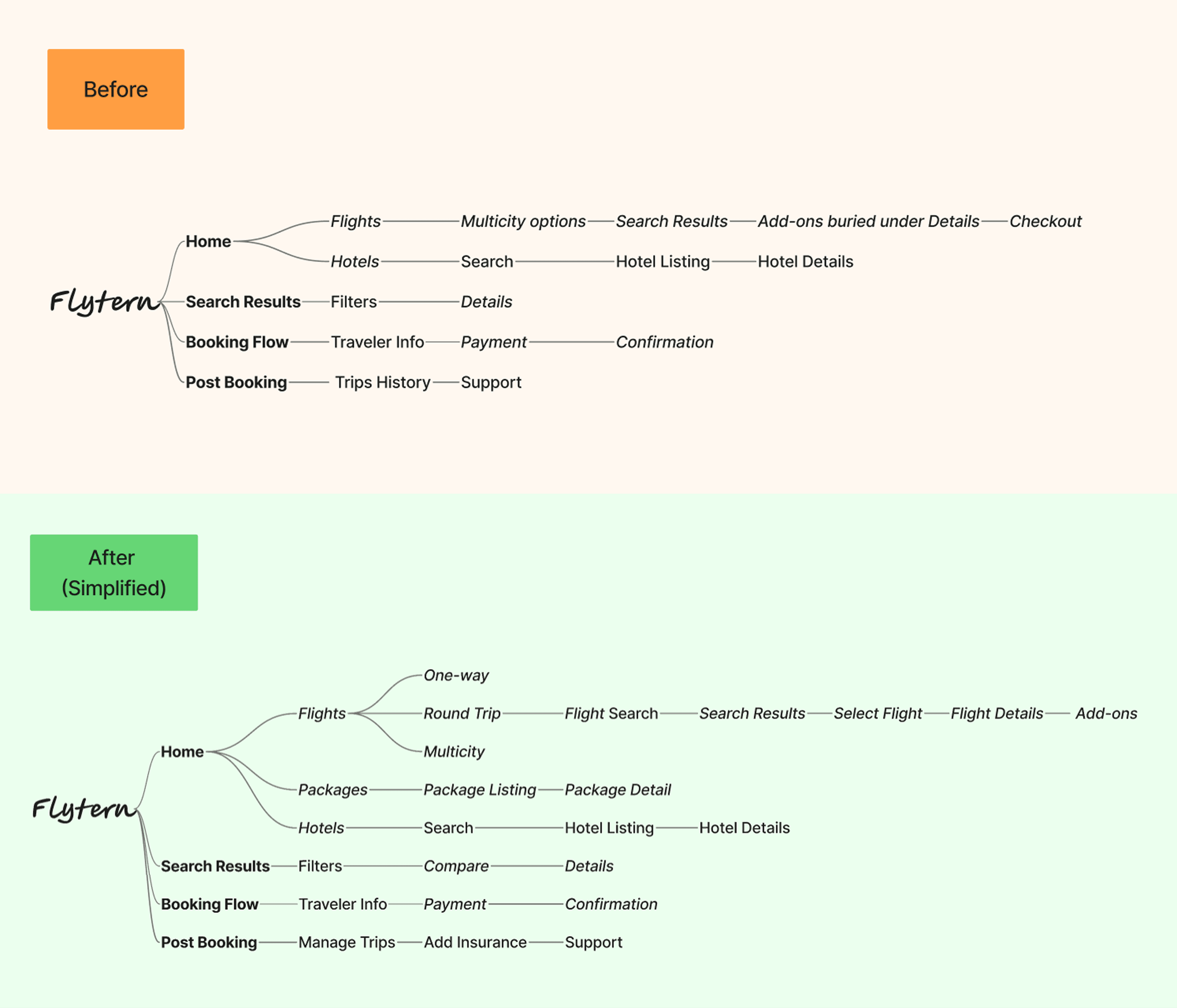
After several iterations, we built a new high-level user flow for Flytern:
After several iterations, we built a new high-level user flow for Flytern:
After several iterations, we built a new high-level user flow for Flytern:
Competitive Analysis
Competitive Analysis
Competitive Analysis
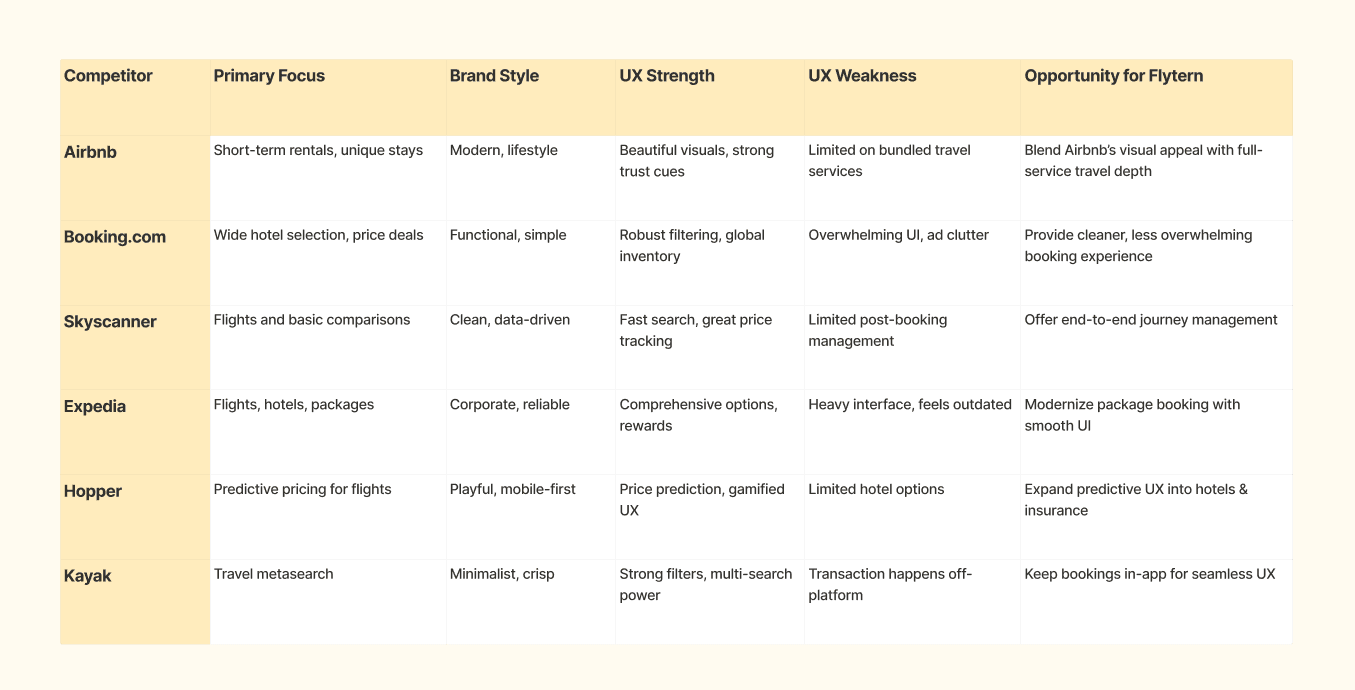
To better understand current booking experiences and identify usability gaps, we analyzed leading travel apps that users frequently mentioned or already rely on.
The evaluation focused on ease of booking, clarity of pricing, comparison features, and extra services like seat selection and travel insurance.
To better understand current booking experiences and identify usability gaps, we analyzed leading travel apps that users frequently mentioned or already rely on.
The evaluation focused on ease of booking, clarity of pricing, comparison features, and extra services like seat selection and travel insurance.
To better understand current booking experiences and identify usability gaps, we analyzed leading travel apps that users frequently mentioned or already rely on.
The evaluation focused on ease of booking, clarity of pricing, comparison features, and extra services like seat selection and travel insurance.
Card Sorting
Card Sorting
Card Sorting
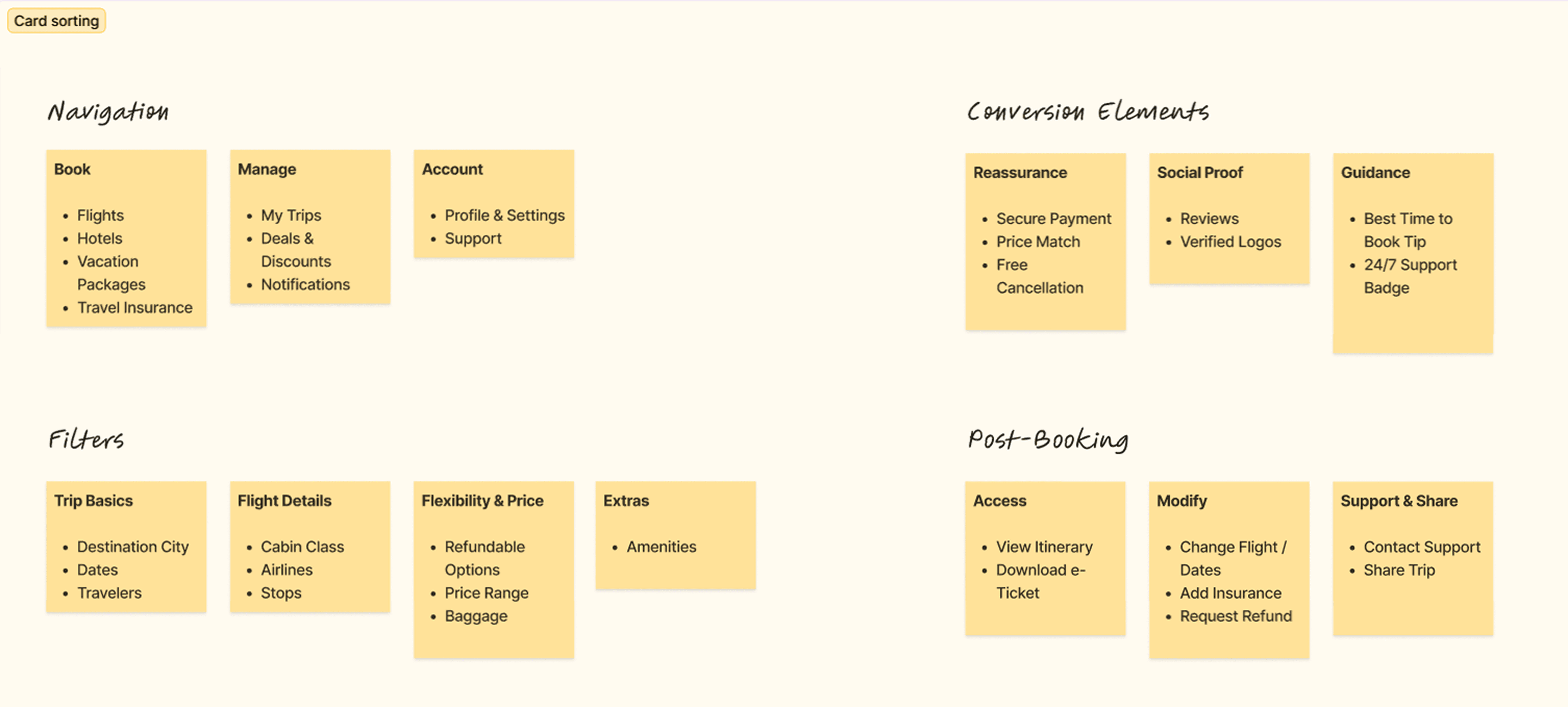
We ran an open card sorting session with 6 users to understand how they mentally group travel features. The resulting categories informed improved discoverability of key actions.
We ran an open card sorting session with 6 users to understand how they mentally group travel features. The resulting categories informed improved discoverability of key actions.
We ran an open card sorting session with 6 users to understand how they mentally group travel features. The resulting categories informed improved discoverability of key actions.
Usability Testing
Usability Testing
Usability Testing
Usability Testing
The usability study helped validate real user behavior and uncover bottlenecks in real time.
The usability study helped validate real user behavior and uncover bottlenecks in real time.
The usability study helped validate real user behavior and uncover bottlenecks in real time.
The usability study helped validate real user behavior and uncover bottlenecks in real time.
User Interviews: 10 participants (aged 20–35, frequent and occasional travelers)
Platform: Conducted via Maze using an interactive Flytern prototype
User Interviews: 10 participants (aged 20–35, frequent and occasional travelers)
Platform: Conducted via Maze using an interactive Flytern prototype
User Interviews: 10 participants (aged 20–35, frequent and occasional travelers)
Platform: Conducted via Maze using an interactive Flytern prototype
User Interviews: 10 participants (aged 20–35, frequent and occasional travelers)
Platform: Conducted via Maze using an interactive Flytern prototype
Tasks Tested
Tasks Tested
Tasks Tested
Tasks Tested
Book a round-trip flight (Zoetermeer → Paris)
Book a round-trip flight (Zoetermeer → Paris)
Book a round-trip flight (Zoetermeer → Paris)
Book a round-trip flight (Zoetermeer → Paris)
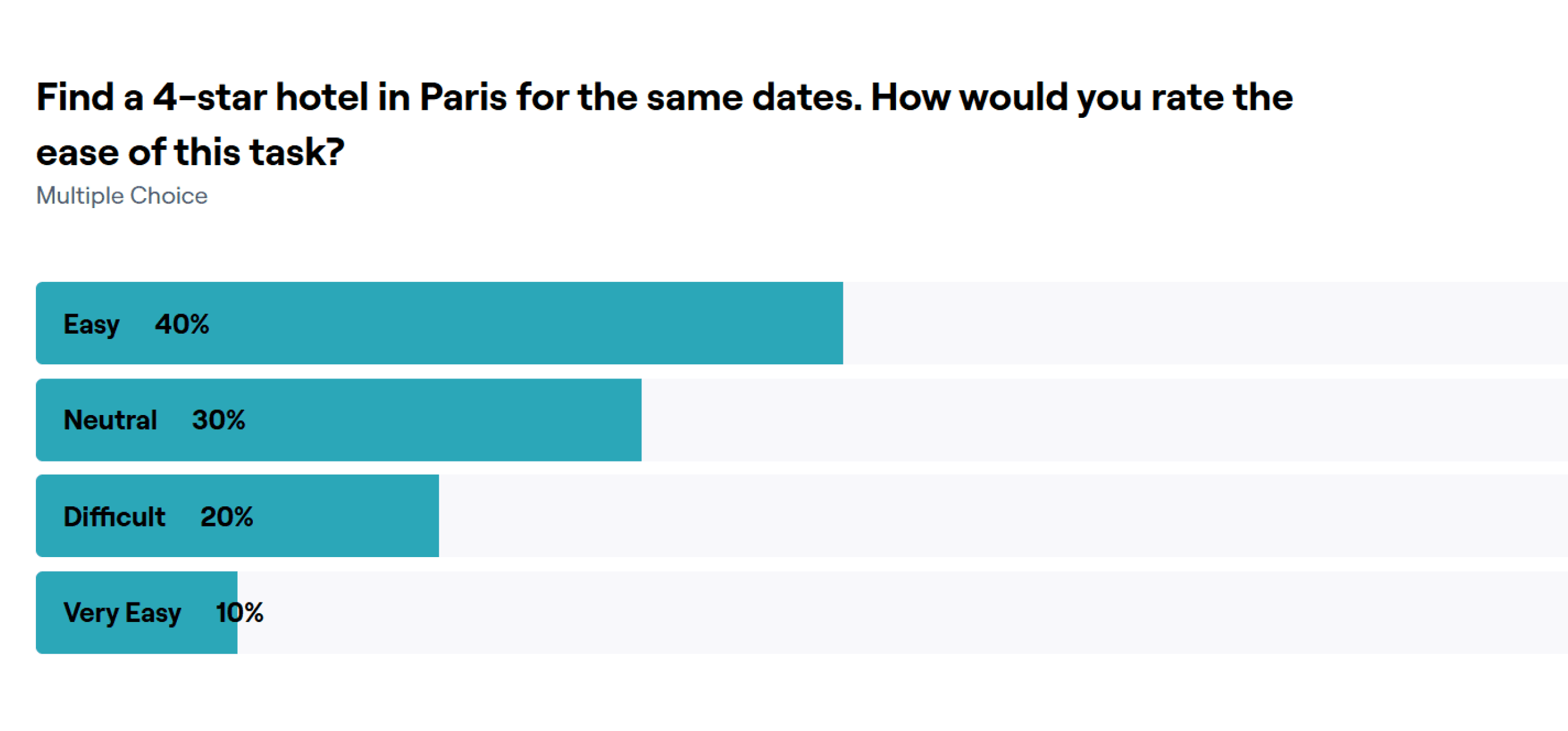
Find a 4-star hotel in Paris
Find a 4-star hotel in Paris
Find a 4-star hotel in Paris
Find a 4-star hotel in Paris
Locate the travel insurance option
Locate the travel insurance option
Locate the travel insurance option
Locate the travel insurance option
Key Findings from Interviews
Key Findings from Interviews
Key Findings from Interviews
Key Findings from Interviews
Maze Test Insights
Maze Test Insights
Maze Test Insights
Maze Test Insights
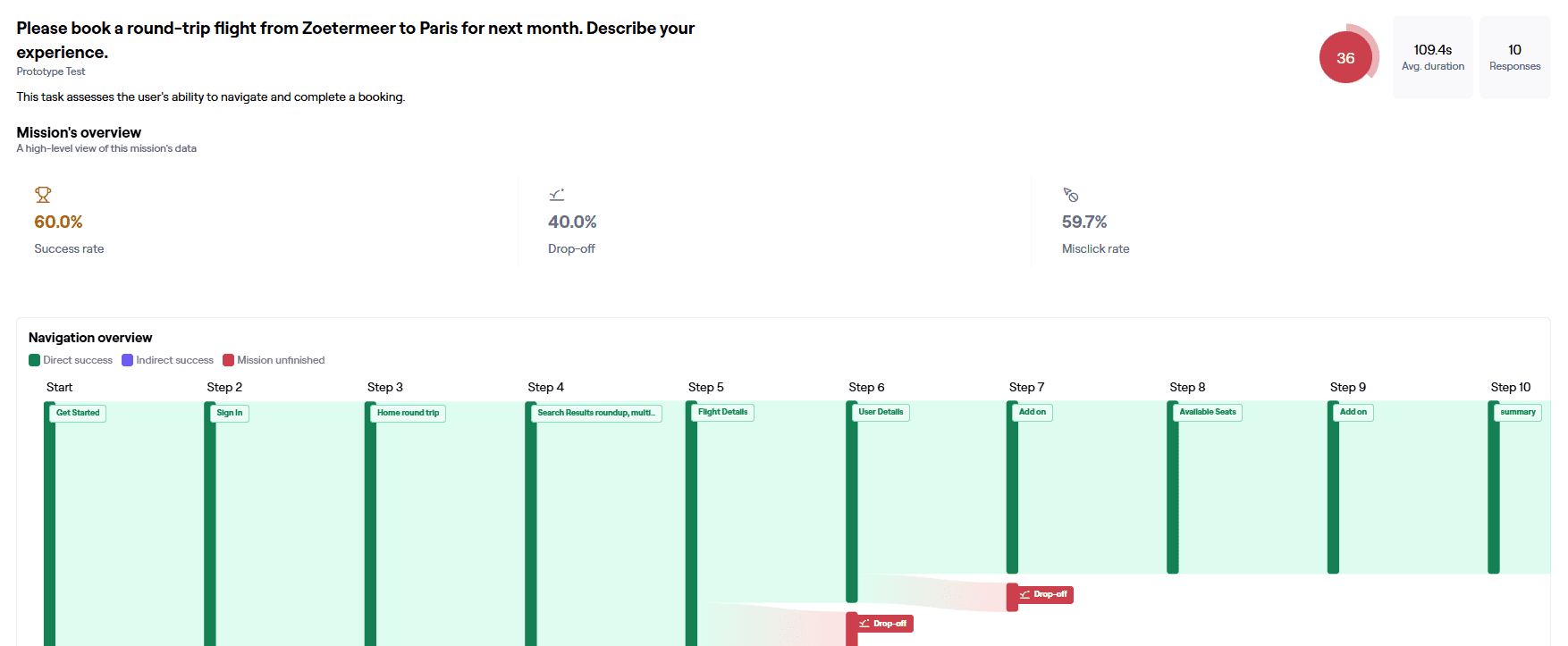
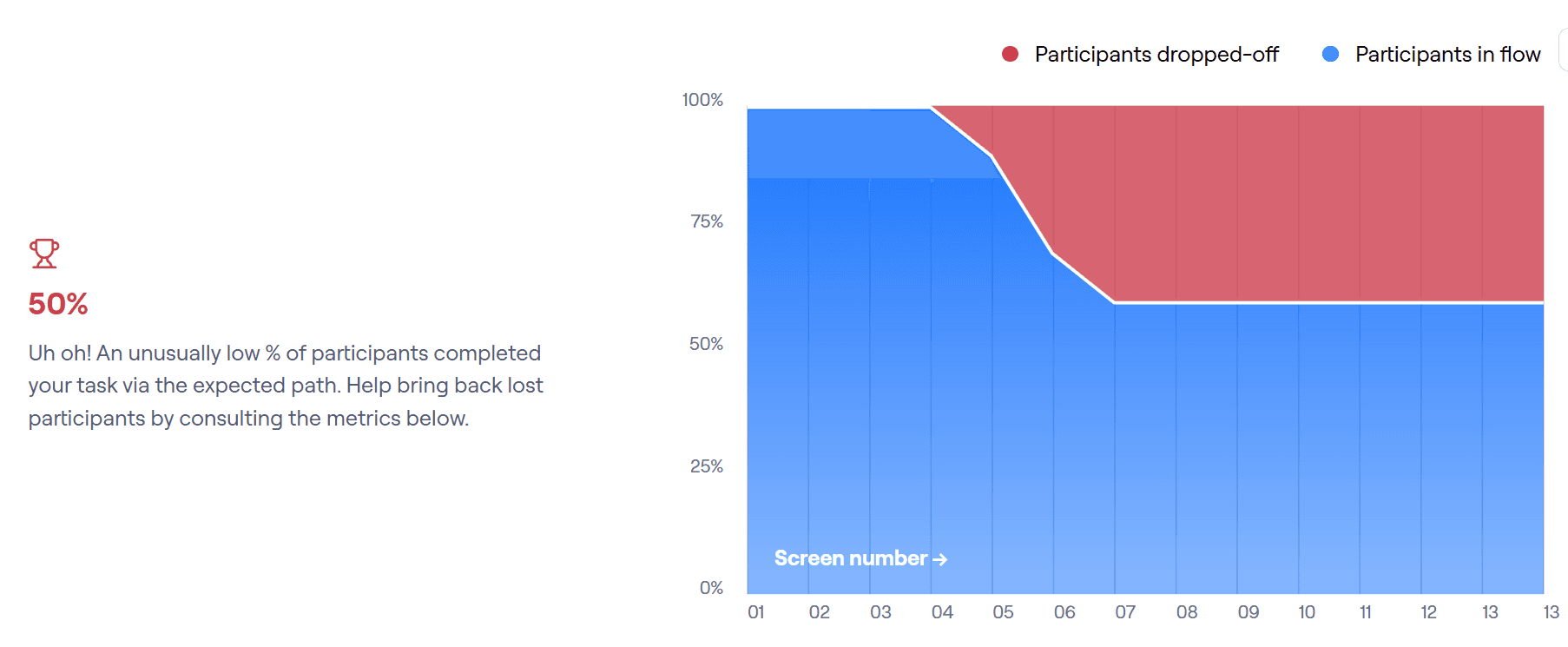

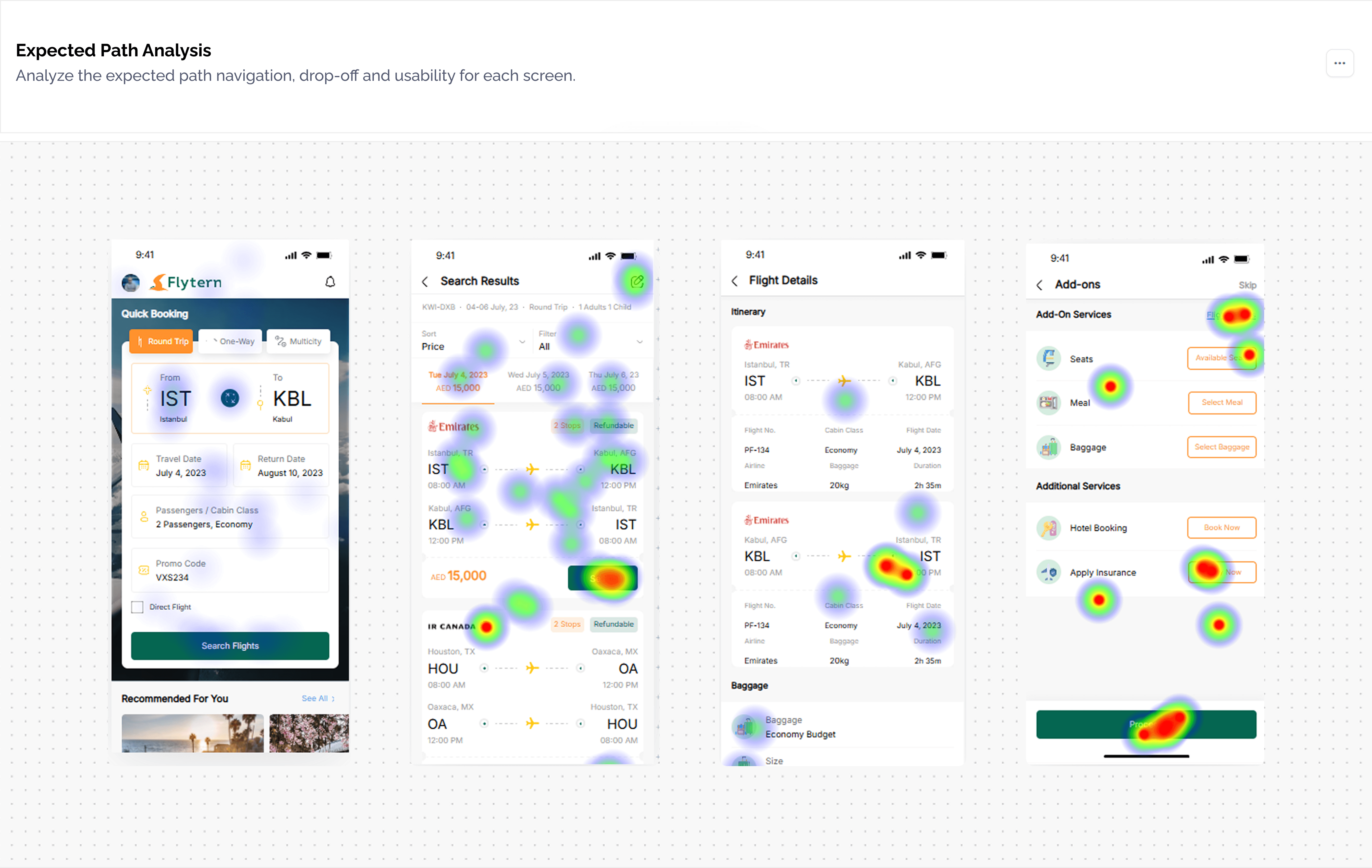
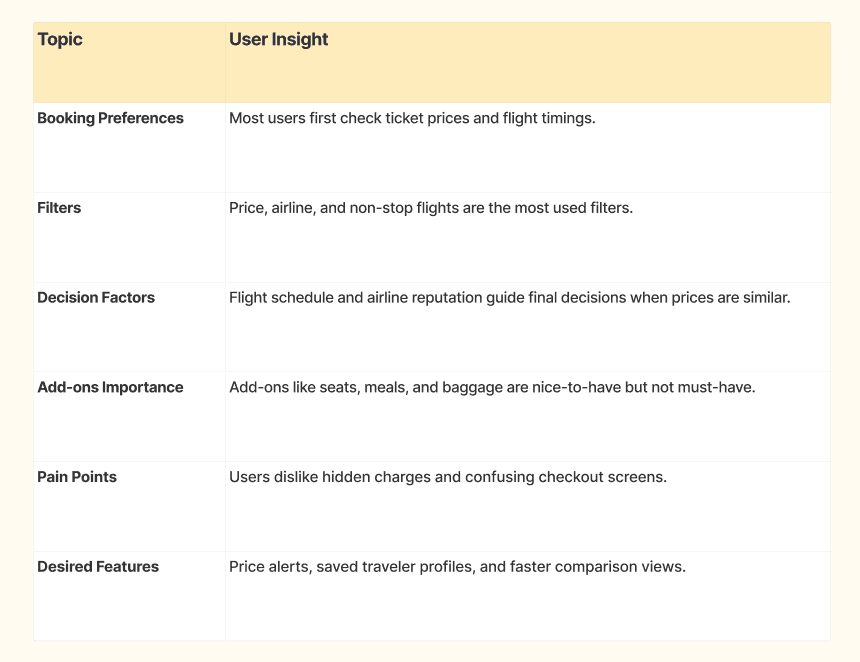
Users struggled to follow the expected booking path due to unclear visual hierarchy and lack of button affordance.
Users struggled to follow the expected booking path due to unclear visual hierarchy and lack of button affordance.
Users struggled to follow the expected booking path due to unclear visual hierarchy and lack of button affordance.
Most users could complete the hotel search, but some struggled with visibility of star rating filters. Better emphasis on filter icons could improve discoverability.
Most users could complete the hotel search, but some struggled with visibility of star rating filters. Better emphasis on filter icons could improve discoverability.
Most users could complete the hotel search, but some struggled with visibility of star rating filters. Better emphasis on filter icons could improve discoverability.
Travel insurance placement was intuitive and easily accessible, strong sign for information architecture.
Travel insurance placement was intuitive and easily accessible, strong sign for information architecture.
Travel insurance placement was intuitive and easily accessible, strong sign for information architecture.
High misclick rates on search and details screens.
High misclick rates on search and details screens.
High misclick rates on search and details screens.
Hidden pricing details causing mistrust.
Hidden pricing details causing mistrust.
Hidden pricing details causing mistrust.
Users appreciated the modern and minimal interface, aligning with Flytern’s goal of a frustration-free booking experience.
Users appreciated the modern and minimal interface, aligning with Flytern’s goal of a frustration-free booking experience.
Users appreciated the modern and minimal interface, aligning with Flytern’s goal of a frustration-free booking experience.
Design Delivery
Design Delivery
Design Delivery
Design Delivery
After testing and iterations, I built high-fidelity prototypes in Figma and prepared design hand-off using proper component documentation for developers.
I worked with the product and development team document feature requirements and prioritize the feature into stories and sprints.
This is how it finally looked like:
After testing and iterations, I built high-fidelity prototypes in Figma and prepared design hand-off using proper component documentation for developers.
I worked with the product and development team document feature requirements and prioritize the feature into stories and sprints.
This is how it finally looked like:
After testing and iterations, I built high-fidelity prototypes in Figma and prepared design hand-off using proper component documentation for developers.
I worked with the product and development team document feature requirements and prioritize the feature into stories and sprints.
This is how it finally looked like:
After testing and iterations, I built high-fidelity prototypes in Figma and prepared design hand-off using proper component documentation for developers.
I worked with the product and development team document feature requirements and prioritize the feature into stories and sprints.
This is how it finally looked like:


Impact
Impact
Impact
Impact
To measure the effectiveness of the improved booking flow, we tracked both usability outcomes during testing and expected product impact post-launch.
To measure the effectiveness of the improved booking flow, we tracked both usability outcomes during testing and expected product impact post-launch.
To measure the effectiveness of the improved booking flow, we tracked both usability outcomes during testing and expected product impact post-launch.
To measure the effectiveness of the improved booking flow, we tracked both usability outcomes during testing and expected product impact post-launch.
During Usability Testing
During Usability Testing
During Usability Testing
During Usability Testing
+25% Faster completion time for booking
+25% Faster completion time for booking
+25% Faster completion time for booking
+25% Faster completion time for booking
Misclick rate reduced noticeably in key screens
Misclick rate reduced noticeably in key screens
Misclick rate reduced noticeably in key screens
Misclick rate reduced noticeably in key screens
Users described the new flow as "clear," "organized," and "easy to follow"
Users described the new flow as "clear," "organized," and "easy to follow"
Users described the new flow as clear, organized, and easy to follow
Users described the new flow as "clear," "organized," and "easy to follow"
After Implementation
After Implementation
After Implementation
After Implementation
Based on observed improvements in task behavior and reduced friction:
Based on observed improvements in task behavior and reduced friction:
Based on observed improvements in task behavior and reduced friction:
60% → ~85%
60% → ~85%
60% → ~85%
60% → ~85%
Booking Success Rate
Booking Success Rate
Booking Success Rate
Booking Success Rate
30–40%
30–40%
30–40%
30–40%
Drop-offs in flight and hotel booking
Drop-offs in flight and hotel booking
Drop-offs in flight and hotel booking
Drop-offs in flight and hotel booking
70% → 95%
70% → 95%
70% → 95%
70% → 95%
Travel insurance discoverability
Travel insurance discoverability
Travel insurance discoverability
Travel insurance discoverability
Conclusion
Conclusion
Conclusion
Conclusion
Through research, usability testing, and design iteration, Flytern evolved into a more intuitive and confident booking experience.
The study proved how data-backed UX design decisions not only improve usability but also build user trust and satisfaction, making travel planning effortless and engaging.
Through research, usability testing, and design iteration, Flytern evolved into a more intuitive and confident booking experience.
The study proved how data-backed UX design decisions not only improve usability but also build user trust and satisfaction, making travel planning effortless and engaging.
Through research, usability testing, and design iteration, Flytern evolved into a more intuitive and confident booking experience.
The study proved how data-backed UX design decisions not only improve usability but also build user trust and satisfaction, making travel planning effortless and engaging.
Through research, usability testing, and design iteration, Flytern evolved into a more intuitive and confident booking experience.
The study proved how data-backed UX design decisions not only improve usability but also build user trust and satisfaction, making travel planning effortless and engaging.

Have an idea?
Let's work together
Let’s turn your vision into a seamless and standout experience
Copyright © 2026 Muntaha. All rights reserved.
Have an idea?
Let's work together
Let’s turn your vision into a seamless and standout experience
Copyright © 2026 Muntaha. All rights reserved.
Have an idea?
Let's work together
Let’s turn your vision into a seamless and standout experience
Copyright © 2026 Muntaha. All rights reserved.
Have an idea?
Let's work together
Let’s turn your vision into a seamless and standout experience
Copyright © 2026 Muntaha. All rights reserved.